
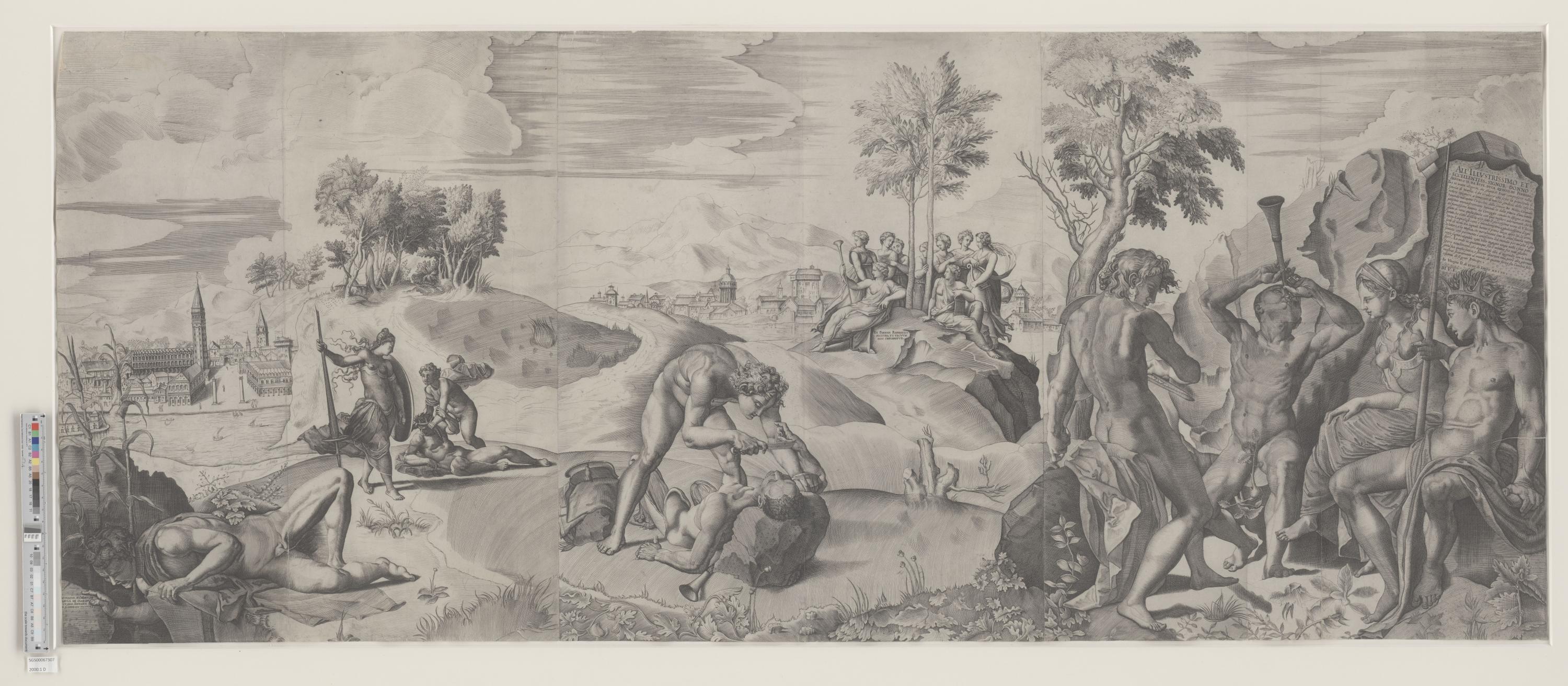
Apoll und Marsyas
Datierung / Date
18. Juli 1562Technik / Material Technique / Material
Kupferstich, von drei PlattenMaße / Dimensions
Blattmaß / Sheet: 512 x 1.244 mmInv.-Nr. / Acc. No.
2000:1 DBeschr. / Inscr.
Beschr. auf Blatt (recto) / Inscr. (recto): "EX PARNASI RAPHAELIS / PICTVRA VT VACVVM / HOC IMPLERETVR." (o.m.)
Beschr. auf Blatt (recto) / Inscr. (recto): "APOLLINIS, ET MARSIAS / (…)ABVLA EX CLARISS. / (…)CTORIS ANTONII / (…)E CORREGIO PICTVRA" (u.l.)
Beschr. auf Blatt (recto) / Inscr. (recto): "ALL’ILLVSTRISSIMO ET / ECCELLENTISS. SIGNOR DONNO / ALFONSO II. DA ESTE, DUCA QVINTO DI FERRARA. / TRA LE MOLTE allegorie, che gliantichi Poeti compresero nella / fauola di Marsia; è da credere che fosse la principale il / uolere insegnare a temerari di non far giudicio delle cose loro / hauendo nell’animo l’orecchie dello sciocco Re Mida, Colquale / utilissimo ammaestramento hauendo io dalla pittura d’una tauola / del famosissimo Antonio da Correggio cauata in disegno, et inta= / gliata in rame questa fauola con quei migliori adornamenti, che ho / potuto, ho eletto di farla uscir sotto il gloriosissimo nome di V Eccel= / lenza. Laquale si come è intendentissima e giudicosissima d’ogni / sorte di uirtù: tra lequali hanno il primo luogo appo lei, le armi, / le lettere e la Musica, che moralmente sono in cotal fauola rappre= / sentate: cosi parimente è conosciuta dal mondo per un’alto e glo= / rioso segno; alquale ogni bello ingegno tenga uolti i suoi pen= / sieri. La onde io, quantunque sia il minimo fra tutti glialtri; / spero nondimeno, che degnandosi ella d’aggradir con la beni= / gnità sua questa fatica, e somma diuotion mia, potrò alla giornata / mostrar sicuramente al mondo di quanta forza sia l’ombra feli= / cissima di si gran Principe. / In Vinegia Il di XVIII di Luglio M D L XII. / DI V. E. / Diuotis et humilis / seruitore / Giulio Sanuto." (o.r.)
WVZ / Cat. Rais.
Le Blanc III.421.7; Passavant VI.105–106.10Literatur / Literature
VENEDIG. La Serenissima. Zeichnung und Druckgraphik aus vier Jahrhunderten, Ausst.-Kat. München, Pinakothek der Moderne, hrsg. von Kurt Zeitler, bearb. von Maria Aresin, Ilka Mestemacher und Kurt Zeitler, München/Berlin: Deutscher Kunstverlag 2022, S. 16, 47, Abb. S. 16
Andreas Plackinger, Violenza. Gewalt als Denkfigur im michelangelesken Kunstdiskurs, hrsg. von Horst Bredekamp und Jürgen Trabant, Actus et Imago. Berliner Schriften für Bildaktforschung und Verkörperungsphilosophie, Band XVII, Berlin / Boston 2016, S. 211-213, Abb. S. 211, Bild Nr. 58
Norberto Gramaccini und Hans Jakob Meier, Die Kunst der Interpretation. Italienische Reproduktionsgrafik 1485-1600, Berlin / München 2009, S. 198-199, Abb. S. 387, Kat.-Nr. 159
Raffael und die Folgen. Das Kunstwerk in Zeitaltern seiner graphischen Reproduzierbarkeit, Ausst.-Kat. Stuttgart, Staatsgalerie / Graphische Sammlung, bearb. von Höper, Corinna, Ostfildern-Ruit 2001, S. 383, --, Kat.-Nr. F 3.3
Dialog über Jahrhunderte. Erwerbungen und Stiftungen 1990 - 2000. Staatliche Graphische Sammlung München, Ausst.-Kat. München, Neue Pinakothek, hrsg. von Tilman Falk, München 2000, S. 86-87, Abb. S. 86-87, Kat.-Nr. 36
Massimo Mussini, Correggio tradotto. Fortuna di Antonio Allegri nella stama di riproduzione fra Cinquecento e Ottocento, Federico Motta, Mailand 1995, S. 242, Abb. S. 242, Kat.-Nr. 524
Giulio Sanuto. A Venetian Engraver of the Sixteenth Century, Ausst.-Kat. National Gallery of Scotland, Edinburgh, bearb. von Michael Bury, Trustees of the National Galleries of Scotland, Edinburgh 1990, S. 12-16, 30-31, Kat.-Nr. 3 (Abb. Plate 5)